Showing posts with label kanji tattoos. Show all posts

A failed tattoo? Not necessarily.

The tattoo in the picture below is often given as an example of a failed tattoo (I've founded the same confusion even on hanzismatter.blogspot, a blog which belongs to someone who seems to have vast knowledge of Chinese and Japanese languages).

ideograms tattoo - chinese meaning = fool, sucker; japanese meaning: Akiko - a very popular female name

If we consider only the Chinese reading of these characters, the tattoo's meaning is "fool, sucker" - 呆 (pronunciation: dai with the first tone) = dull; dull-minded, simple, stupid; 子 (pronunciation: zi with the third tone) = offspring, child; together they form the word 呆子 (daizi) which means "fool, stupid, sucker".

On the other hand, in Japanese 呆子 is just one of the nearly 300 ways (I know, it's hard to believe that there are really that many) to write the popular name "Akiko".

In conclusion, this is not (such) a failed tattoo.

Similar posts:
Stupidity is painful

Another failed kanji / hanzi tattoo

A cool guy... or a bad woman?

Tattoos fails: kanji / hanzi mistakes

He has hemorrhoids... and he is proud with that

Failed tatoos: Kanji mistakes - the seven virtues of the samurai

Stupidity is painful

I've often heard that stupidity is painful - and recently I found the proof. For the beginning, let's keep in mind two facts about tattoos:

1. Getting a tattoo is a pretty painful process.
2. It's really silly to get a Kanji / Hanzi tattoo without getting informed about the Kanji / Hanzi 's meaning.

Now, with this two things in mind, let's take a look at this tattoo:


The very first problem is that the top character is upside down. But that is just a small problem.

The real problem is the meaning of these ideograms:

The the top character (苦) means "pain; suffering; distress; anxiety; trouble".
The next two ideograms (阿呆) mean "fool; simpleton; idiot".

The tattoo's meaning is something like "suffering idiot" or "a fool in pain" or "distressed simpleton" or something of this kind.

In conclusion, stupidity is really painful.

Similar posts:
Another failed kanji / hanzi tattoo

A cool guy... or a bad woman?

Tattoos fails: kanji / hanzi mistakes

He has hemorrhoids... and he is proud with that

Failed tatoos: Kanji mistakes - the seven virtues of the samurai

A cool guy... or a bad woman?

Recently I found this image on freetattoos.net (the image's url is: http://www.freetattoos.net/designs/8890)

First, let's take a look at the picture:

kanji fails: the kanji for 'bad woman' tattooed on a man's shoulder


Well, I don't know what this dude thinks about his tattoo and why is he so proud of it because the meaning of the tattoo (悪女; reading: akujo) is "bad woman" or "wicked woman" which, let's face it, isn't exactly an appropriate tattoo for a man. But who knows, maybe he is trying to get in touch with his feminine side :)

Now, let's see what the person who uploaded the picture thinks about it:

title="Tattoo of Chinese Letters Kanji on the Back" (the description of the image is included in the Html code to share on Myspace, Blogs and other Social Networks:)

As if it weren't bad enough that the tattoo itself is pretty weird, the description is even worse:
1. The Chinese ideograms are called Hanzi and the Japanese ideograms are called Kanji. The "Chinese Letters Kanji" is a nonsense.
2. Both the Hanzi and the Kanji are ideograms, not letters (is a big difference between the two concepts)
3. The ideograms of the tattoo are Kanji, not Hanzi, because the ideogram 悪 is not used in Chinese; in Chinese we have those ideograms instead: 惡 (in the traditional Chinese) and 恶 (in the modern / simplified Chinese)

A japanese proverb: Even monkeys fall out the trees

Hi, everyone. In this post I'd like to present you a nice japanese proverb: Even monkeys fall out the trees (japanese pronunciation: Saru mo ki kara ochiru)

This proverb reminds us that everyone, even the best, make mistakes, so is better not to become overconfident in our own skills/knowledge/power/abilities, etc. On the other hand, this proverb reminds us that mistakes do happen and we should be tolerant when others make mistakes.

This japanese proverb is equivalent with the latin dictum "Errare humanum est" (=to err is human).

In the image below you can see this proverb written in japanese:


japanese proverb: Even monkeys fall out the trees


If you want to print this image (or to use it for a tattoo) you can find the image without watermark on my website, www.seiza.ro

Tattoos fails: kanji / hanzi mistakes

Recently I found this image on ratemyink.com:
the chinese 5 steps / phases tattoo

and here is the description of the image, sent by the tattoo's owner: "This is technically my third tattoo. The artist is Dan Greuling from Creepy Creations in Londonderry, NH. With my design idea, Dan did the entire work freehand. The symbols come from the Five Phase (constructive/destructive) Cycle of Traditional Chinese Medicine (clockwsise from top: wood, fire, earth, metal, and water). They show growth and break down ie. how everything is connected. The root system now extends down to my left foot ending in the double koru. There is much more to this. Please ask. (For those who don't know how this website (ratemyink.com) is working: if you have a tattoo and you want to find out what other people think about your tattoo, you can send a picture with the tattoo along with a short explanation about the meaning of the tattoo.)

Unfortunately, the symbol on the top of the tattoo is not the ideogram for tree, but a meaningless phonetic katakana syllable 'ho'. The "tree / wood / timber" symbol (木) has no hook at the bottom and the 3rd and 4th strokes are attached to the 1st. In the image below you can see both the ideogram for "wood / tree" and the katakana character "ho":
the kanji / hanzi for tree / wood vs the katakana character ho


In conclusion, before you get a Kanji / Hanzi tattoo it's better to spend some time researching the authenticity of the symbols’ meaning.

Failed tatoos: Kanji mistakes - the seven virtues of the samurai

Well, this is happens when you get a kanji (or hanzi) tattoo without consulting someone who is knowledgeable and trustworthy. This is one of the worst kanji tattoos I've ever seen (and I've seen a lot of silly tattoos).

First, let's take a look at the image below: the seven virtues of the samurai, written in kanji. I've choose a common type of fonts - MS Gothic.


the seven virtues of the samurai written in kanji

Now let's take a look at this photo:
kanji tattoo fail: the seven virtues of the samurai
It's obvious that the tattoo is a completely lame.

Let's take a closer look at the ideograms tattooed on this dude's body:

The first kanji, tattooed on the neck: two strokes are missing (the strokes from the top) and the ideogram has been splitted into two parts: 王 (king, monarch) and 我 (I, me). In the image below is a standard depiction of this kanji:
kanji for tattoos: the seven virtues of the samurai: gi = rectitude


The second and the third kanji seem to be well written.

The 4th kanji is missing a stroke. In the image below is a standard depiction of this kanji:
kanji for tattoos: the seven virtues of the samurai: rei = respect


The 5th kanji is a total mess: a stroke is missing (in the upper right corner of the kanji) and the radical looks like an independent character. In the image below is a standard depiction of this kanji:
kanji for tattoos: the seven virtues of the samurai: makoto = honesty


The 6th word is composed of two kanji characters (名 - distinguished / name / reputation and 誉 - glory / honor /praise / reputation). When a word is composed of two or more kanji, all the kanji must have the same size and must be written on the same line. In the image below is a standard depiction of this word:
kanji for tattoos: the seven virtues of the samurai: meiyo = honor


As for the last word - Loyalty - this word can be written with one ideogram (like he did) or with two ideograms, like this: 忠義. Considering the awful drawing of the word above (honor), it was the a wise decision to choose the simpler variant :)

Tribal heart tattoo

Hi! In this post I'll present you two of my favorites tattoos:

tribal heart tattoo and kanji tattoo
Tribal heart tattoo 1. Ideogram meaning: 失恋 disappointed love / broken heart / unrequited love. Japanese: kanji: 失恋; hiragana: しつれん; reading: shitsuren. Simplified chinese: Hànzì: 失恋; pinyin: shīliàn

ideograms tattoo, tribal heart tattoo
Tribal heart tattoo 2. Ideogram meaning: 失恋 disappointed love / broken heart / unrequited love. Japanese: kanji: 失恋; hiragana: しつれん; reading: shitsuren. Simplified chinese: Hànzì: 失恋; pinyin: shīliàn

Usually when I draw a tattoo I try to integrate one or more ideograms (either japanese Kanji or chinese Hanzi) in various tribal or floral patterns. In this case, I've used some tribal-style hearts and the word 失恋 (disappointed love / unrequited love / to lose one's love / being lovelorn).
This word (失恋) has the same meaning both in chinese and in japanese (of course, the pronunciations are different: the japanese pronunciation is shitsuren and the chinese pronunciation is shīliàn - first tone and the fourth tone).


If you like these two tattoos you can find them (and many others) on my website, www.seiza.ro.

A tattoo for those who love the japanese poetry (1)

Hi!

Here's my last tattoo-design for those who love Japan and the japanese culture: a haiku written by Kobayshi Issa: "Yo no naka wa / Jigoku no ue no / Hanami kana" = In this world, We walk above the hell, Gazing at flowers (or: In this world / We walk on the roof of Hell / Gazing at flowers)". The second translation is more beautiful but less correct: "ue" means "above; up; over", no roof.


First, let's see the design:
Kanji tattoo / haiku tattoo

In the image above are two variants of the same Haiku. There is a little difference between these two variants - the last word of the third verse is written in hiragana in the first variant (in the right side of the image) and  in kanji in the second variant (in the lest side of the image). Both variants are correct - the word "kana" (an emphatic word, equivalent with "Alas!") can be written in kanji, but usually is written in hiragana.

In the image above, I've split the Haiku in three lines (following the three phrases of the Haiku); anyway, traditionally, the Haiku were printed in a single vertical line, like this:

The Haiku written on a single vertical line. In this variant, I've written the last word of the Haiku in hiragana. (there are 3 lines because I've written the same Haiku with 3 types of fonts - just choose the one you like the most):
Kanji tattoo / haiku tattoo

The Haiku written on a single vertical line. In this variant, I've written the last word of the Haiku in kanji. (there are 3 lines because I've written the same Haiku with 3 types of fonts - just choose the one you like the most):
Kanji tattoo / haiku tattoo


There is no first attack in karate

The second of the Gichin Funakoshi’s 20 Guiding Principles of Karate: 'There is no first attack in karate'. This principle remind us that karate is for defense only. A karateka will never instigate violence or perpetuate it's development; only, as a last resort, will a karateka use his skill to end a fight. Japanese text: 空手に先手なし (からてにせんてなし); reading: karate ni sente nashi.


Japanese writing tattoo / Kanji tattoo: the second of the Gichin Funakoshi’s 20 Guiding Principles of Karate

Wu xing tattoos

Tattoo design: the Wu Xing elements. In the middle is depicted the ideogram of the Element of Fire (火, huǒ).

Tribal tattoo / wu xing tattoo / the chinese five elements tattoo

For more tattoos designs with the Wu Xing ideograms visit our website, seiza.ro

Free dragon tattoo designs (II)

chinese symbol for the year of the dragon
Chinese symbol for the year of the dragon (Hànzì: 龙年; pinyin: lóngnián)

tribal tattoo / kanji tattoo
Japanese symbol: War (Kanji: 戦争; hiragana: せんそう; reading: sensoo)

yin yang tattoo / dragon tattoo / kanji tattoo
Chinese (traditional chinese) / japanese ideogram: Dragon (Japanese: Kanji: 龍; hiragana: 1 たつ 2 りゅう 3 りょう; reading: 1 tatsu 2 ryuu 3 ryoo) (Chinese: Hànzì: 龍; pinyin: lóng)

Kanji tattoo: Human emotions

kanji tattoo: human emotions (japanese word)

Japanese word:喜怒哀楽 (きどあいらく = kidoairaku), human emotions. Ideograms meanings (from left): 1. 喜 Joy. 2. 怒 Angry. 3. 哀 Sorrow, grief. 4. 楽 Good mood, comfort.

Scorpion tattoos


One of the most popular symbol for tattoos, used both for men's tattoos and women's tattoos, scorpion tattoos can be tattooed at any part of the body.
Depending on the design, a scorpion tattoo can be dark and forbidding, elegant and sophisticated or sexy and attractive.


tribal tattoo, black scorpion tattoo, shoulder tattoo, arm tattoo
Tribal scorpions are done in black and gray. This kind of tattoo looks pretty tough and is more suited for men.


Realistic scorpion tattoo; wrist tattoo, hand tattoo
Unisex design


scorpion tattoo, tribal tattoo, tattoo on the back
Unisex tribal tattoo with scorpion


Scorpion tattoo on the side of the body of a young woman
Sexy scorpion tattoo


tribal tattoo / scorpion tattoo / zodiac tattoo / sign of the Scorpion written in Kanji

On seiza.ro you can find this tribal tattoo with the kanji for the zodiacal sign of the Scorpion. Japanese language: Scorpio (zodiac sign) 蝎座 (Kanji: 蝎座; hiragana: さそりざ; reading: sasoriza)


Japanese symbol for luck

Trebol tattoo; kanji tattoo; the japanese symbol for good luck
Japanese language: good luck; fortune; happiness 
Kanji: 幸; hiragana: 1. さち; 2. こう; reading: 1. sachi; 2 koo


Free tattoo from our website, seiza.ro. It combine two symbols for good luck: a clover and the kanji which means happiness, good luck.

Tattoo colors

Here are some of the things that you should know about tattoo colors:
Black:
The best thing about black is that it does not fade over time. This is the main reason that many people choose to get their tattoos done entirely in black. Your tattoo will always be easy to see when you get it done in black, even if it does begin to fade over time. Keep in mind that gray, which is similar to black, will also remain brilliant over time.
White
One of the biggest problems with white tattoos is that they fade very quickly. Due to the sun, white tattoos often turn light brown or yellow in color. Many people also find that in comparison to other tattoo colors, white tends to be a much more painful option. The reason is because the tattoo artist  will need to penetrate somewhat further into the skin for the color to be visible.
Pink and Red
These two colors are known to fade much more gradually than other tattoo ink colors. Keep in mind that it is best to opt for a bright or dark pink if you want to keep the tattoo looking brilliant. It is important to make sure that you are not allergic to pink or red before getting your tattoo done, however. These are the two most common tattoo ink colors for people to be allergic to.
Blue and Purple
In comparison to many other tattoo ink colors, blue and purple are not known to fade too quickly. To ensure that your tattoo will keep its lustrous color for years to come, it is a good idea to opt for dark or bold, bright shades of these colors. Violet and turquoise are two tattoo ink colors which can remain beautiful over time in your desgn.  Light purples and blues will fade much quicker.
Yellow and Green
To avoid significant fading, it is a good idea to stay away from yellow and green tattoo ink. Not only do they fade the most significantly, but they also fade over the quickest amount of time. Although these colors can be great for accents, it is best to avoid having the entire tattoo done in yellow or green.
Coiled snake tattoo; blue snake tattoo; ideogram tattoo

Snake tattoo, available on seiza.ro

Kanji tattoo: The seven virtues of the samurai

Tribal tattoo; kanji tattoo; Bushido written in Kanji; the seven virtues of the samurai written in japanese

Inside: 武士道 Bushido. Outside (starting from top, clockwise): Rectitude (義), Courage (勇), Benevolence (仁), Honor (名誉), Loyalty (忠義), Honesty (誠), Respect (礼).

Love in japanese

One of the most popular phrases in any language is probably “I love you.” In Japanese, “love” is “ai (愛),” and the verb form “to love” is “aisuru (愛する).” “I love you” can be literally translated as “aishite imasu (愛しています)”. “Aishiteru (愛してる),” “aishiteru yo (愛してるよ)” or “aishiteru wa (愛してるわ, female speech)” is normally used in conversation. However, the Japanese don’t say “I love you” as often as Western people do, because of cultural differences.
butterflies tattoo; kanji tattoo; love written in chinese / japanese

Ai tattoo
There is another word to describe “love” which is “koi(恋).” The kanji character for “kokoro (心, heart)” is included as part of both kanji characters.


butterflies tattoo; heart tattoo; kanji tattoo; love written in chinese / japanese
Koi tattoo

Both “ai (愛)” and “koi(恋)” can roughly be translated as “love” in English. However, they have a slightly different nuance. “Koi” is a love for the opposite sex, or a longing feeling for a specific person. It can be described as “romantic love” or “passionate love.” While “ai” has the same meaning as “koi,” it also has a definition of a general feeling of love. “Koi” can be selfish, but “ai” is a real love. Here are some lines that explain them well:
“Koi is always wanting. Ai is always giving.”


Warrior spirit - kanji tattoo

Tattoo with kanji for warrior spirit

Japanese symbol: 闘魂 - Warrior spirit (Kanji: 闘魂; hiragana: とうこん; reading: tookon)

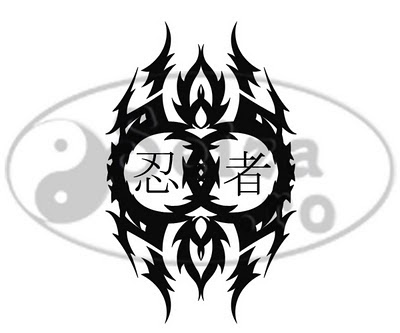
Kanji for ninja - tattoo

tribal tattoo; kanji for ninja
Japanese symbol: Ninja (Kanji: 忍者; hiragana: にんじゃ; reading: ninja)

 
© Copyright 2035 TATTOO DESIGNS
Theme by Yusuf Fikri